

When I got diagnosed with bipolar II and adult ADHD, I didn’t go into shock. I went into something quieter, a kind of recognition, an “oh, it makes sense now,” and I mean that in a very literal way, because so many things that I had been dragging around since I was a kid suddenly lined up and stopped looking like just “personality” like I used to call it before. For years people resolved me with a phrase, “that’s just Yeiner” and I resolved myself with the same phrase, I never sat down to ask why I was like that, or even to give the behavior a little more room than “that’s my nature, nothing to do.” It was a very simplistic view of my life, and I had been living inside it ever since I was a child.
Since I was a kid I had moments of absolute anxiety, of a despair I couldn’t explain, of a sadness that arrived without a source, crises that I watched happen to me without being able to tell you what they were for. I also didn’t know that those two things, the crises and the way my attention worked, were going to spend the rest of my life talking to each other.
Yeiner is scatterbrained (el despistado)
I was the kid who forgot the instructions. They would send me to the store and I would get there and not know why I had come. I used to just drop my things: the backpack, the book, the notebook. I would walk into a room and stand there for a second, honestly lost, and the family turned that into a joke, almost a fixed bit, Yeiner is scatterbrained, Yeiner is scatterbrained, and I normalized it because as a kid losing a pen was not going to destroy me. I could live my life being the despistado. I really thought that.
Adulthood changes the color of the same habit. Losing the pen at work is no longer cute, and I started having serious problems retaining information, collecting facts, knowing what I actually had to do in order to deliver on a commitment. The consequences were ugly, and I covered them with systems, my systems, not the ones other people swore by -- i.e I learned the hard way to just forget about GTD and all those flashy super complicated processes, my brain just doesn’t work that way; and now AI is such a blessing and making this even easier. The day I found one process that actually works for me I started to breathe. I’ll talk about the system another day. What I want today is the other side of the diagnosis, the one that explained why, in school, I was a hypernerd. So this is a ride I’m gonna guide you through my teenage years, hope you like it!
Two equations, two variables.
I would concentrate in an absurd way on what I liked and evaporate from what I didn’t. Math and English, yes. Economics, philosophy, politics, no. In seventh grade I learned positive and negative numbers and something opened and started clicking in my brain, not yet the thing, just the feeling that math had more rooms than I had been told -- like, wait a minute, so you’re telling me that numbers aren’t only infinite forward but also backwards? Are you kidding me?
The first catalytic moment was ninth grade. I entered the year late, they had already been going for weeks, I had to catch up, and then the equations appeared, two equations, two variables, and I have no way to explain what I felt. I wanted to solve equations all the time. I wanted books of equations. I wanted to stay inside that small magic and not come out. Later that year came the 3x3 ones, then the quadratics, then the graphs, and my head was almost exploding to the point that, in sickness I would dream (or have nightmares even) about abstract mathematic operations my mind was just making up, this is the way a vocation explodes when you are fifteen and still allowed to be naive. I decided I was going to be a math teacher in the United States, because that joined the two things I liked, and I was very sure, and I was very wrong about how visas work, but that is a different essay.
We never beat the baker.
In tenth grade I was in a dangerous school in Medellín, the kind of place that took the kids no other school wanted. They smoked marijuana and cigarettes in the classroom. There were knife fights in the classroom. I was fifteen, it was 2004, and that is where I met one of my very first best friends in life (Elder, yeah, that’s his name); we became friends because he was calm and studious and we were among the four or five people in a class of forty-nine who didn’t carry anything, didn’t fight, didn’t do the bullying. We studied, we played video games, we played soccer, we played Tío Rico, which is the Colombian Monopoly, and we played chess, lots and lots of chess. Not long ago he visited me and we remembered the baker on the corner of my house, the one we sat down to play chess against and could never beat, no matter how much we tried, like even today when someone talks to me about a badass person in any fashion in life I just can’t help but imagine the baker’s face, that’s just how good he was. I also trained taekwondo, I was a yellow belt, that sometimes made me a target, because they assumed that if I knew martial arts I wanted to fight, which was never true.

The quality of the teaching was bad enough that I learned the basics of trigonometry and almost nothing else, sine, cosine, tangent, Pythagoras, a right triangle on a page. At the end of the year I told my mom I was not going to graduate there. She told me to find the school myself and she would help me with the tuition. The one I was leaving cost, in today’s money, about eight dollars a year, a public school, subsidized, a symbolic fee. The one I found cost about thirty, still public, still subsidized, not vastly better. They still smoked in the classroom, there was still bullying, but I could study, and I met another friend (Josimar) who taught me something I didn’t have language for at fifteen, how to show affection between friends without a filter; and by the way, remember my “hungry friend” story on this essay? that friend was Josimar.
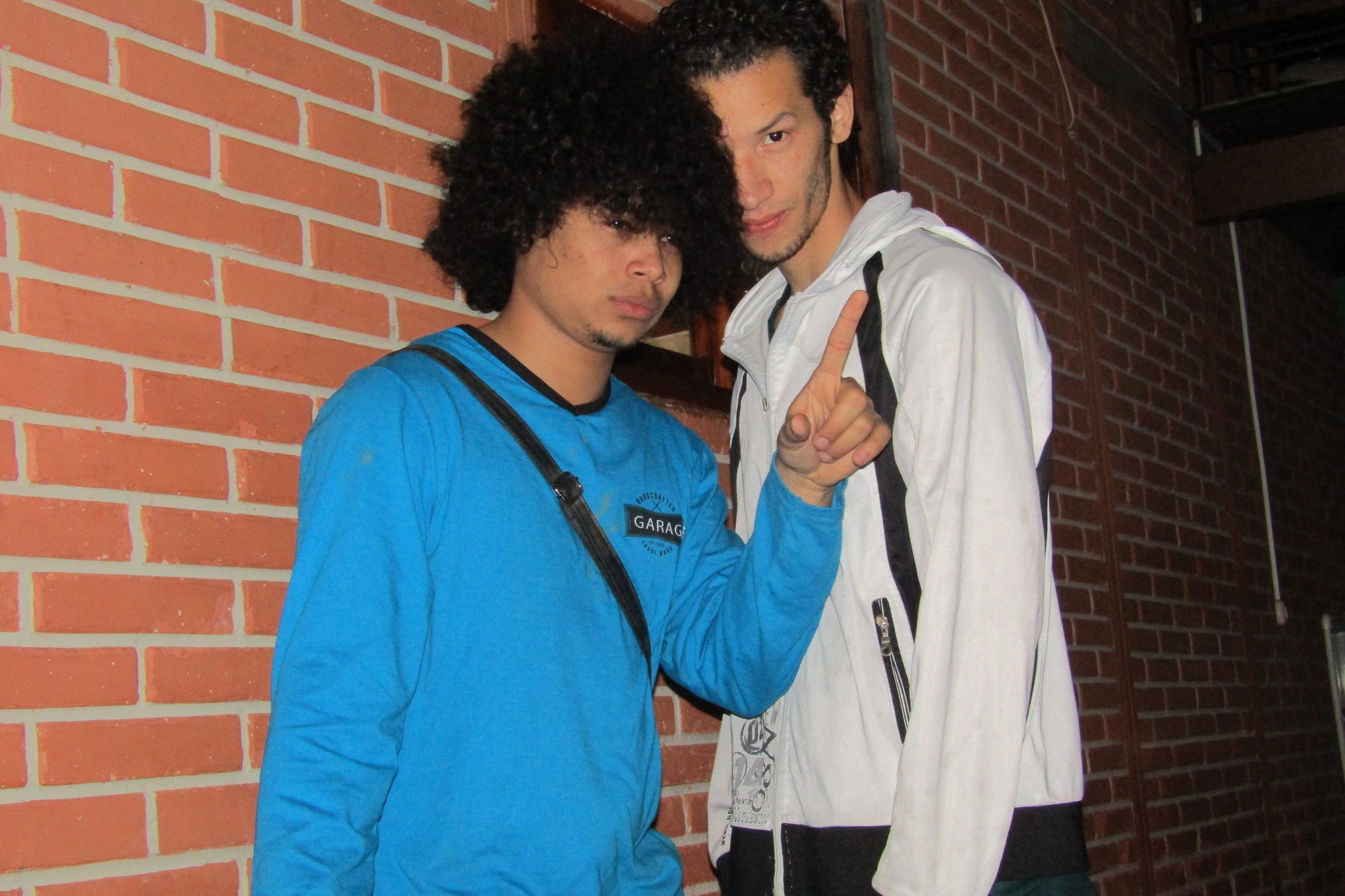
By then the vocation was already sitting in my head, licenciatura in mathematics, then somehow the United States, and then the ICFES got close. If you don’t know what the ICFES are, it’s a nation-wide final exam all students have to do in 11th grade (last in Colombia) to graduate and pursue higher education. I went to the Saturday prep sessions every week, I didn’t miss them, I didn’t throw paper balls, I didn’t talk. When I like something, or when I have a big goal in my head, I can go to a level of concentration that does not look like “getting my act together.” It looks like something else. My goal was a score that would impress, including the people in my family who had never believed much in me.
“I’m going to beat you.”
There was a mock exam. I got the highest score in the class, in the school, and my two best friends at the time, Josimar and Paula, came over. Paula hugged me and told me I had done really well, and that on the real exam she was going to beat me. I asked her if she was sure. I told her I was not going to allow it. She said she was sure.
That challenge lit me up. I came from taekwondo, I had already won gold, and my competitive streak could not admit that my best friend at the time would pass me. I studied twice as much, three times as much, libraries, practice tests, more practice tests. The catalytic moment, if I am honest, was not the exam, I’m pretty sure it was Paula’s dare.
The night before the real test I slept amazingly (wanted to be super sharp for the exam). I brought a pencil and an eraser. I saw Paula and Josimar right before looking at my assigned seat, we wished each other good luck. I sat in the assigned seat and answered hundreds of questions, a three or four hour exam, and people were leaving after half an hour, after an hour, and that gave me a little anxiety, am I overthinking this, but I kept going. By the way, I wasn’t bilingual, in a public school in Colombia the English is bad, and the English section in the ICFES was entirely in English, and I did it anyway, carefully, one question after another.
When I came out, Paula and Josimar were waiting. I was highly surprised when Paula said she had finished a while ago. She asked me how it went, I said I thought it went well, however, the fact that she finished that fast stayed in my head for weeks. I didn’t understand how you finish a test like that so quickly unless you are not answering it carefully or unless you’re a super genius. The only option? Wait till the results, that’s it.
When the results came out I was walking toward them and Paula ran up and hugged me again and told me I had done extremely well, that she was proud of me. The question I actually wanted to ask her was whether I had beaten her or not, that’s all that mattered. I didn’t ask it as I was just about to find out. I didn’t have to ask, she told me I had come in first in the school again, and “wait for it and look at this yourself”, and I looked, and next to the school ranking there was the municipal ranking, and I was place 23 among thousands.
I am still living that.
The day my family got proud.
That score opened a scholarship at a municipal technology institute. I wanted a math teaching degree but the scholarship options were not that, they were sistemas or electrónica, two doors, and I had to pick one. I haven’t graduated yet in this part of the story, by the way. I am still in eleventh grade, still a kid with a number next to his name, and the number is already rearranging the next years.
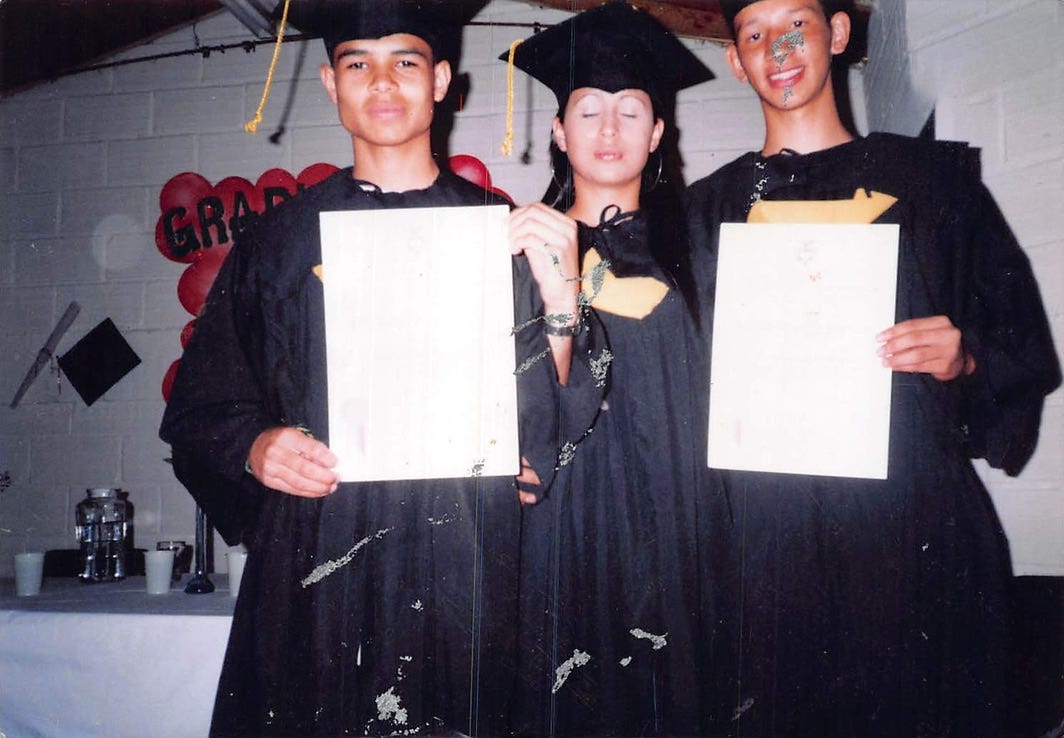
Then came graduation. I think it was the happiest day of my family, the ones who hadn’t had much faith in me felt proud, and I accepted the scholarship after that, not before, and I started tecnología en sistemas because I thought, very naively, that I was going to learn how to use the computer and the second reason was because I saw a lot of mathematics in the curriculum. I had no idea that what you learned there was programming, I didn’t know that word, I didn’t know that existed.
A little later I understood that using the computer I would have to learn outside, and that inside what was waiting for me was this strange thing called programming, something I couldn’t have named the year I learned negative numbers.
If I put it in a line it still gives me a little vertigo. Negative numbers -> Equations in ninth -> Wanting to be a teacher -> The school I left -> Paula’s dare -> The ICFES -> Place 23 -> Graduation -> A scholarship I accepted without knowing what sistemas was. Definitely an avalanche of butterfly effects stacked one over the other, and in a way that is just overwhelming for me to make sense of.
This avalanche of events where the ones that shaped up my career, helped me impress a beautiful girl when we were 17 (and 20yrs later today she’s still the love of my life), and is giving me infinite ways to inspire my kids and close friends.
I’ll go deeper into these in future essays. For now, let me make just some closing remarks.
Closing Remarks -- how I’m working around my diagnosis, so many years later
Since the diagnosis, which was already several years ago, I have learned few things that truly help me. I have learned to notice when I fall into a rabbit hole and I am playing at productivity without producing, trying workflows, overcomplicating the system, and sometimes I even accept that as a hobby, which sounds ridiculous until you live with ADHD and realize that the thing that actually works is the simplest possible version of the work. I have learned to never trust my memory, my wife says I have the memory of a chicken, and she is right, so I take everything out of my head, notebook, notes, whatever, because my memory is the least reliable tool I own. I have learned that it is okay to have many interests, that I want to be ten things at the same time: cook, photographer, writer, the person who finally learns the bass, a speed cuber, manga collector, singer, etc; having many interests used to make me feel guilty, as if a person with too many interests was the most unproductive person in the room. I understand now that it’s mine, and that I am never going to be good at everything, and that I can obsess over something for a season and then put it down, and that that’s okay too.
The diagnosis did not fix me. It named a few of the rooms I had been walking through in the dark. I still lose the pen, I still fall into a rabbit hole and call it work, I still want to be ten things at once. The difference is that now, when that happens, I have a quieter sentence for it, and I don’t have to turn it into a personality, or a joke, or a problem I am supposed to solve before I go to sleep.
I am still living the first butterfly effect, and I am still, slowly, making sense of the rest.